
Software's Calculator Moment
How AI codegen is compressing engineers, companies, and markets


Calculators didn’t let mathematicians do their work faster. The work changed entirely. Is software engineering facing the same?
The tech world is talking about three things these days: Claude Code, Claude Code for things that aren’t code, and Claude’s maker Anthropic.
Most benchmarks for coding capabilities have only marginally improved in the last year. But both the technical and non-technical community are amazed by the step-change in usability and agentic capability in the latest wave of models released in late 2025 - especially Opus 4.5 on Claude Code.
The last weeks alone: X flooded with impressive vibe-coded holiday projects. DHH, vocal skeptic, reversing his view on AI-generated code. Cursor’s agents building a browser from scratch in a week. Anthropic’s CEO at Davos predicting we’re 6 to 12 months away from AI systems that can do everything software engineers do.
Where does this inflection point lead? A compression is playing out at three levels: engineers, companies, and markets.
What happens when writing code stops being the job
AI is reshaping knowledge work, and software engineers are experiencing it first.
Despite the gap between the pace of codegen advancements and expectations within the software community, software engineering is going from human-written to fully autonomous at remarkable speed. In five years, we went from AI-assisted to AI-written.
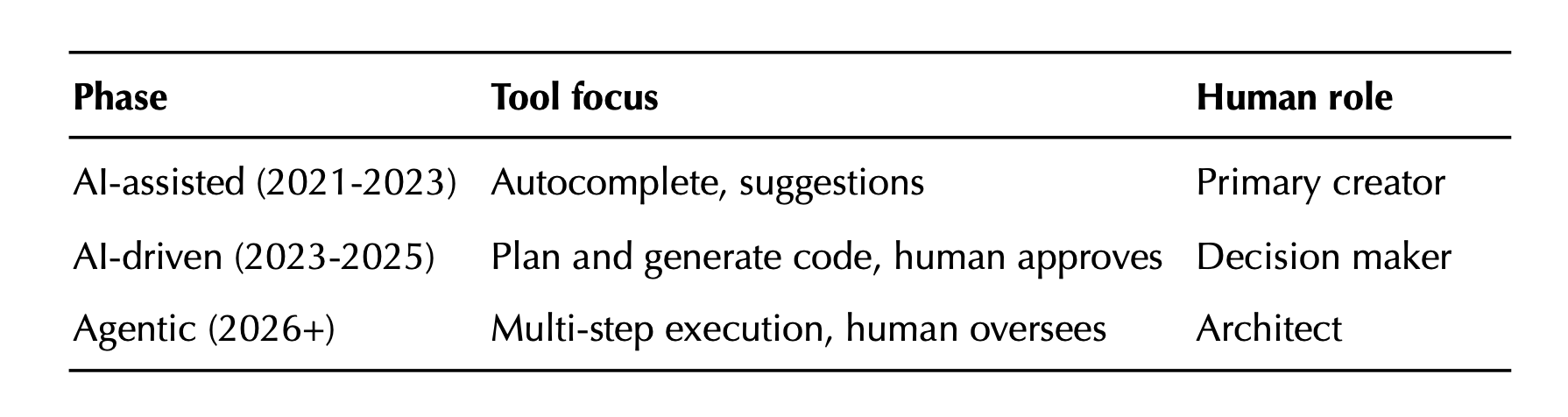
Claude Code, especially with Opus 4.5, looks to be software engineering’s calculator moment.
In Math, computer calculators led to a clear separation between computation and mathematics. Solving equations is different from developing new mathematical proofs.
Now, computation (writing code) is becoming mechanical. What remains is conceptual: architecture, scoping, judgment.
Already, the ‘middle work’ of software is disappearing.
While VCs, founders, and newly minted vibe-coders rejoice in a world of creativity, experienced software engineers are less excited.
Automation is usually assumed to take the grunt work away. Engineers are discovering the opposite. They feel their passion, the part they loved - the craft of writing code - is what’s eaten by automation. The ‘boring’ work - scoping, testing, reviewing - is what’s left.
For engineers that spent thousands of hours learning to write code, watching a machine do in minutes what took them hours isn’t an efficiency win. They’re losing an identity they built over years. A skill they staked their career on is being commoditized.
Some business-minded engineers might thrive when knowing what to build matters most. But many engineers genuinely liked writing code - that was the point.
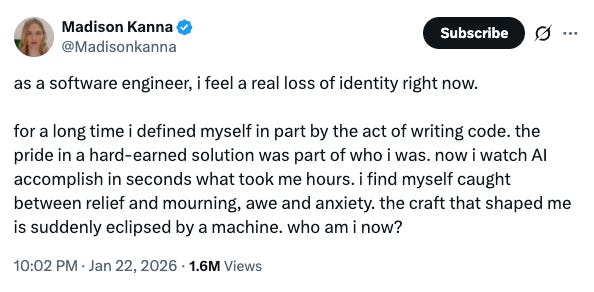
Skeptics have moved on from the argument that AI won’t be able to write production-level code. This seems too hard to argue when looking at Claude Code being predominantly written by AI and scaled to millions of users. The new focus of argumentation emphasizes that coding isn’t software engineering altogether - and the profession’s real strength was engineering always. I still believe this will prove a momentary limitation.
The biggest question: Do software problems expand outward (like math did) or compress inward? Do engineers fragment into subspecialties, consolidate, or something new?
When computers entered math, computer science itself was net new - an entirely different problem domain that didn’t exist before. Same with computational statistics creating massive new job categories.
So far, no new disciplines have emerged. Prompt engineering didn’t last. AI engineering is still, at its core, software engineering - not a fundamentally different job.
New subspecialties historically take decades to form. We’re 2-3 years in. Too early to call. But it’s worth preparing for a world where software engineering compresses.
Fewer people, faster loops
If software engineering is compressing at the individual level, that compression is amplified inside companies. The best teams are rebuilding how they work - with fewer people.
A big driver of this is the above-mentioned ‘disappearing messy middle’. Most organizations used to spend weeks or months on the work between an initial idea and shipping to customers. Not anymore. That shifts where time and attention go.
New pressure points emerged: output control (how to review all that generated code) and dependencies (how to parallelize agent work). Both are important to solve, but software’s real new bottleneck is upstream in the formation of clear intent (what to build).
Companies always wanted full-stack engineers for versatility and cost efficiency. But as the software stack kept expanding - React, TypeScript, containerization, microservices - it was incredibly rare for candidates to master all of it. T-shaped specialization was the compromise we hired for.
Codegen is collapsing this stack complexity. Wix just merged all engineering titles into “xEngineer.” With AI handling the mechanical work, the focus shifts to people who can own end-to-end - not only in engineering, but across the whole product org.
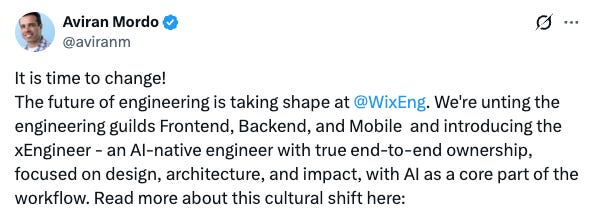
As a result, conventional team structures are dissolving. The interplay between product, design, and engineering becomes much more fuzzy and fluid - all in for pace. Talking to customers with vibe-coded prototypes is standard now. Building 20 versions of an idea before committing isn’t unusual. Experimentation velocity has increased dramatically.
Beyond product teams, codegen unlocks parts of the org that were bottlenecked by engineering access. For some companies, this matters even more for efficiency and growth.
There’s a big but to all the good news. Your company moves faster - so do competitors and customer expectations.
The new failure mode is PMF collapse. Losing PMF after finding it was rare in the last decade of software. Now it’s a real worry for founders. Lovable’s Elena Verna describes this as the need to find product-market fit every three months - instead of building something that people want and scale it from there.
Best practices within product teams will shift multiple times over the next years. Common workflows, like the Agile methodology, were optimized for producing less code more carefully, since producing code was expensive. It’s the wrong approach for a world where writing code is low-cost and low-effort.
The canary is indie software
Enterprise SaaS is the obvious test: does cheap code lead to churn? Investors and founders are watching. But the data tells a different story.
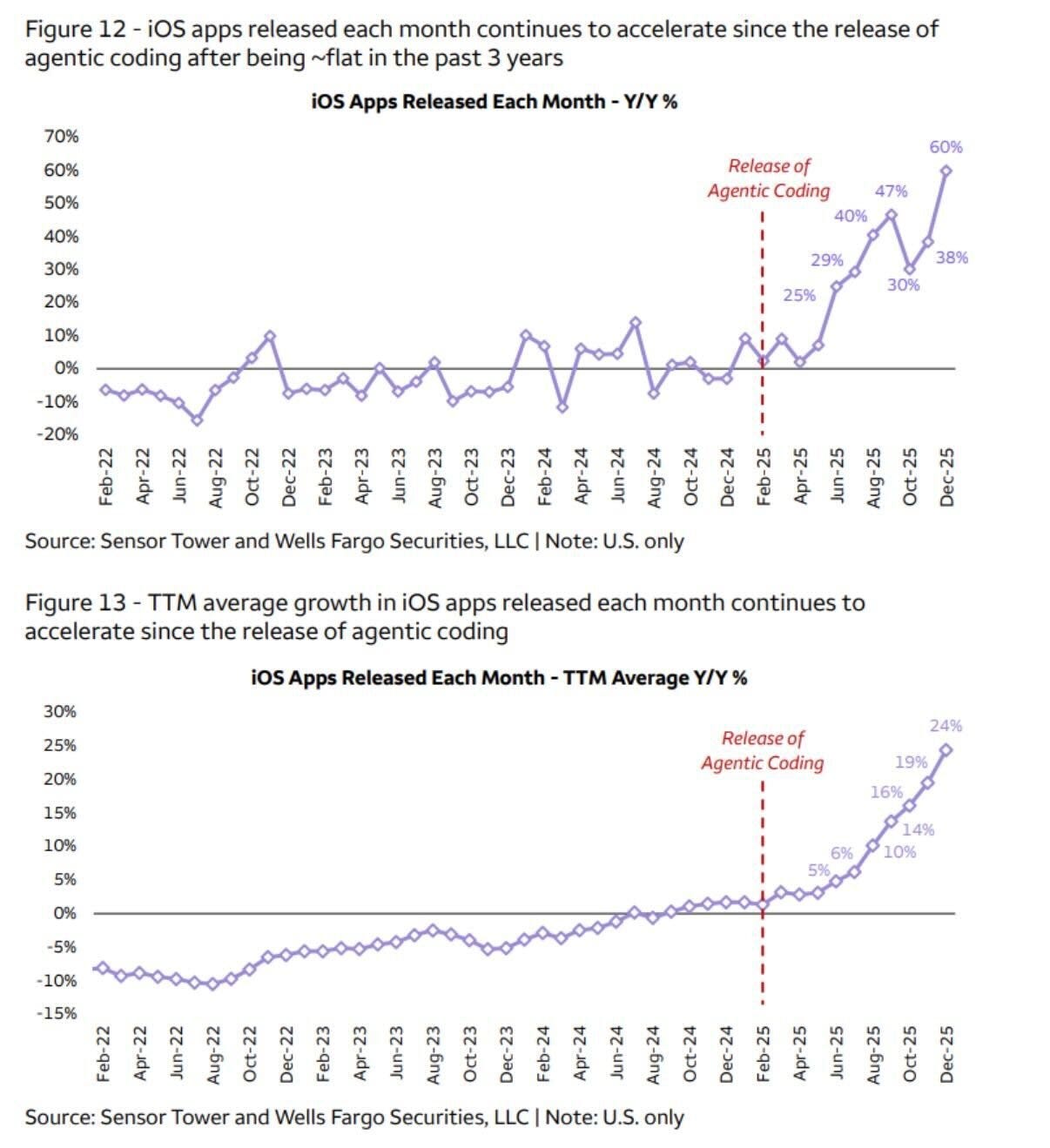
Take iOS app releases. They held steady from 2022 to 2024. Starting February 2025, the numbers climbed - accelerating to 60% year-over-year growth by December, coinciding with Opus 4.5.
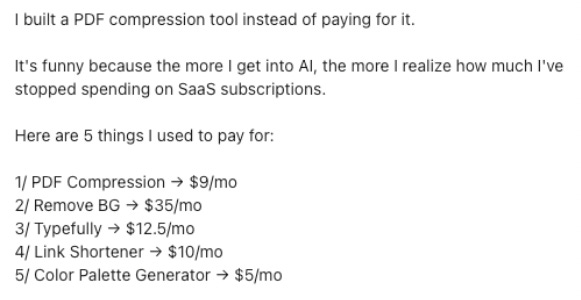
SaaS churn is starting to show - but it’s hitting narrow-focus indie tools, not enterprise. Productivity apps are getting replaced by vibe-coded alternatives - Lovable’s Felix Haas swapped out multiple tools for custom builds. Models aren’t eating these use cases. Self-coded solutions are.
Infrastructure faces a different dynamic. Tailwind CSS monthly downloads are at all-time highs, driven by AI codegen tools that love generating Tailwind code. Revenue down 80%. The same tools driving adoption skip the docs where paid products get discovered. Usage and value capture are decoupling.
Meanwhile, the big players show no signs of significant churn. X users love pointing out that AI labs run on exactly the clunky enterprise software they’re supposedly disrupting - Anthropic on Workday, OpenAI on Salesforce. Integration depth, workflow lock-in, switching costs, compliance requirements - these still protect enterprise. At least for now.
Markets have noticed. Two years ago, investors bought any decent AI story. Now they’ve learned to discriminate between real AI tailwinds and bolted-on narratives.
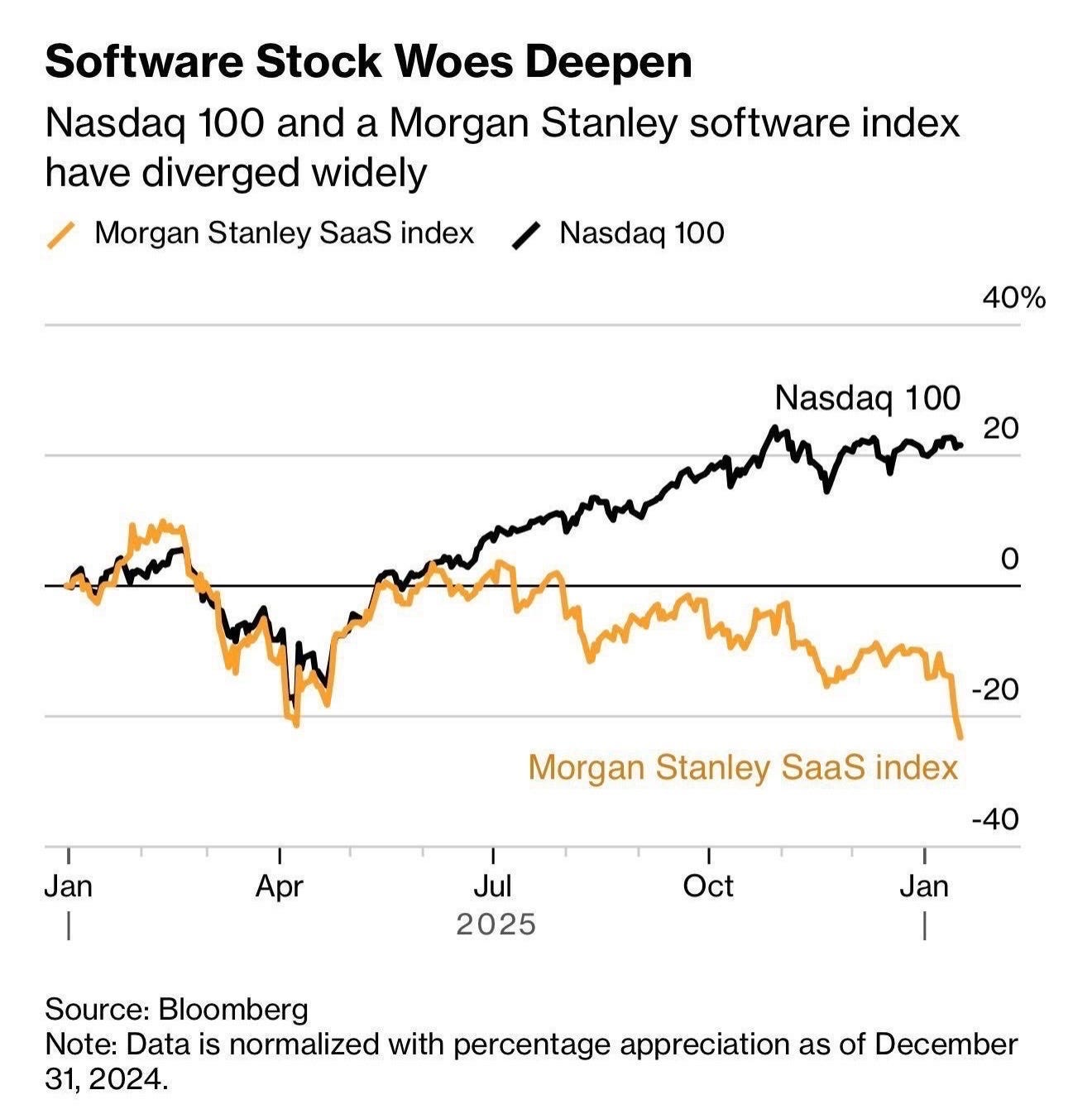
Public SaaS multiples compressed from 12x to 5x in twelve months. Since ChatGPT’s launch, Nasdaq 100 is up over 100%. Software? Up 19%. But the pressure isn’t uniform. The spread between top and bottom decile multiples has blown out to 16x, versus a historical norm of 3-4x.
ServiceNow is the case study. 52% on the Rule of 40, 31% operating margin, Q4 beat, AI revenue exceeding $600M - double the prior year. The stock dropped 12% anyway. The fundamentals are strong. The problem: ServiceNow’s AI traction reads as defensive, bolting AI onto a mature workflow business. Palantir, trading at 65x sales, is seen as riding the wave - AI is the business.
There is some irony in all this. Many expected AI to supercharge indie hackers. It did - which is exactly why their products are first to get replaced. If you can vibe-code a tool in a weekend, so can your users. Indie tools are the canary; enterprise SaaS still has runway. But the market is pricing in a future where that runway ends.
Software isn’t math
Imagine being a mathematician in 1936. You calculate by hand. Most of your work is what we’d now call being a ‘human computer.’ Someone named Turing just described a universal computing machine.
If someone told you that the number of mathematicians would actually grow substantially while your job was fully automated, would you believe it?
That’s what happened. Computers created new mathematical problems - algorithmic complexity, cryptography, optimization at scale. The mechanical work disappeared; the applications of mathematical thinking exploded into domains that didn’t exist before.
Math and software share the same structure: a mechanical layer (arithmetic / code generation) and a conceptual layer (theory / architecture). Both now have tools automating the mechanical. The question is whether the outcome will be similar.
The mathematician in 1936 couldn’t have known. They saw their daily work being automated and reasonably assumed compression. They were wrong - but they couldn’t have seen the new problem domains that automation would create.
For software, my bet is compression. Hire for leverage, not headcount. Build moats that aren’t code.
But we’re standing in the same fog. For mathematicians in 1936, the answer was expansion. For software engineers in 2026, the signs point to compression. We’re still early enough to be wrong.
Your calculator analogy. My Pilates instuctor codes now.
"Wix just merged all engineering titles into “xEngineer.” With AI handling the mechanical work, the focus shifts to people who can own end-to-end - not only in engineering, but across the whole product org." > Interesting, we are seeing the reverse. Since most of the job is shifting to planning and reviewing, specialisation leads to more efficiency in our case.